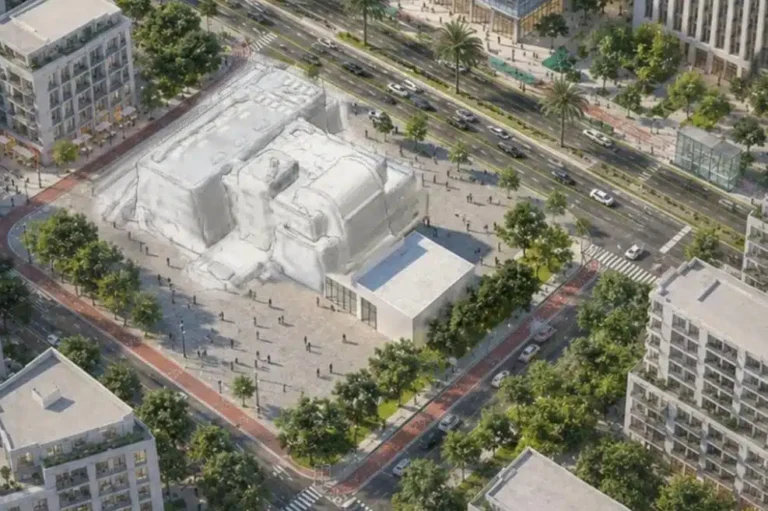
Mikumi | An imagined vision of 2040, not a description of an approved development plan
Good Morning, Ahuza
It is 8:30 on a Tuesday morning in the spring of 2040. A metro train arrives at a station beneath Ahuza Street, and dozens of passengers emerge into the sunlight. Some are heading to work, others have come for meetings, shopping or leisure. Ahuza is no longer simply Ra'anana's main commercial street. It has become a vibrant urban center where people live, work, meet and spend time together.
Wide sidewalks are filled with pedestrians, children walk to school beneath the trees, and cyclists travel along dedicated lanes. Cafés are busy, while small squares and green gardens invite people to stop and linger. The constant noise of traffic has given way to conversations, laughter and the sounds of urban life. A street that once functioned primarily as a traffic corridor has become the beating heart of Ra'anana.
Where Home and Work Meet
On the ground floor of a new building, a neighborhood bakery opens for the day. Above it are coworking spaces, a medical clinic and small offices. The upper floors are home to families, couples and single residents. At nine o'clock, one resident heads downstairs for coffee before going up to her office on the second floor. Her commute takes three minutes. Her partner walks to the metro station, while their children head to school with friends from the neighborhood.
This is the idea behind mixed-use development: bringing housing, employment, retail and services together rather than separating them into different districts. The result is fewer unnecessary journeys, stronger local economic activity and more opportunities for people to interact. In the afternoon, the family will meet in the shared garden before heading downstairs for dinner at a small restaurant overlooking the square.
The Metro Changed More Than Transportation
Homebuyers once asked how many parking spaces came with an apartment. In the imagined Ra'anana of 2040, the question has changed: How many minutes does it take to walk from home to the nearest metro station? Public transportation has become a convenient choice for many residents. Workers and students can reach employment centers throughout the metropolitan area, while local businesses benefit from visitors arriving from across the region.
But the metro has also transformed urban planning. New districts combining housing, workplaces and retail have developed around the stations. Development has become more intensive in suitable locations, alongside investment in sidewalks, green spaces and public areas. Ra'anana has discovered that urban growth and quality of life can reinforce one another.
The Return of the Main Street
For years, shopping malls drew commercial activity away from traditional urban streets. Ahuza in 2040 tells a different story. Bookstores, bakeries, restaurants, galleries and independent shops operate alongside offices and residential buildings. In the morning, cafés serve workers and residents. During the day, customers arrive at local businesses. In the evening, restaurants attract families and younger visitors.
The street remains active beyond conventional business hours because people live above the shops and spend time in the surrounding public spaces. This is not simply a nostalgic return to the main street of the past, but an urban economic model in which commerce, housing and community support one another.
And What Happened to the Community?
Perhaps the most important change is not immediately visible. Residential buildings include shared spaces for workshops, gatherings and recreational activities. A garden connecting neighboring buildings hosts a small market featuring local producers, while outdoor film screenings take place during the summer.
There are still disagreements about noise, parking and the use of shared facilities, but the physical environment creates opportunities for people to meet. A community is not created simply by opening a WhatsApp group or designing an attractive residents' lounge. It develops when people have places to gather and experiences to share. Good urban planning cannot manufacture friendships, but it can help them grow.
Not Every Building Needs to Be a Tower
Ahuza Street in 2040 is not an endless row of identical high-rise buildings. Preserved older structures stand alongside new buildings of different heights, small squares and green pedestrian passages. Urban renewal has not erased the street's identity. Instead, it has added new layers to its history. Traditional storefronts remain active, while new development has introduced homes, workplaces and public services.
Density is no longer automatically viewed as a negative concept, but neither is it treated as an end in itself. The question is what residents receive in return for additional construction: better transportation, public spaces, infrastructure and services? Successful urban renewal is measured by the quality of life it creates, not merely by the number of apartments built.
An Afternoon in the New Square
It is 5:30 in the afternoon. Three generations of one family are sitting together in a small square near Ahuza Street. The grandmother lives in a nearby building, while her daughter and grandchildren live just five minutes away on foot. The children have returned from an activity at the neighborhood community center. Around them are young families, workers finishing their day and residents enjoying the shade of the trees.
A longtime shop owner looks across the square and remembers when customers struggled to find parking and traffic jams dominated the street. Now he smiles. "People used to rush through Ahuza. Today, they come here because they want to stay."
Back to 2026: The Future Begins Now
Everything described here is an imagined vision, not an approved plan or a prediction. Yet the principles behind it are already shaping urban planning around the world: mixed-use development, transit-oriented neighborhoods, walkable public spaces and community-centered design.
Ra'anana is also facing important questions about its future. As Mikumi has reported, the urban renewal plan for Ahuza Street seeks to reshape the city center through additional housing, commercial space and employment opportunities. At the same time, Ra'anana's comprehensive master plan and preparations for four planned metro stations raise questions about density, transportation, neighborhood connectivity and preserving the city's character.
How will the metro integrate into the existing city? Where should new development be concentrated? And how can growth improve everyday life for residents and business owners? The answers require professional planning, infrastructure investment, public participation and a willingness to address competing interests. But before designing the next building, it is worth asking: What kind of city do we want to create?
The future of Ahuza Street will not be determined solely by the number of floors built along it, but by the life that unfolds between its buildings. Perhaps, when we walk along Ahuza Street in 2040, we will discover that the greatest transformation did not take place underground, where the metro runs, but above it — in the way we learned to live together.
The Future of Ahuza Starts Now: Join the Conversation
What will happen above the metro stations? How will urban renewal transform Ahuza Street, and what will these changes mean for residents, property owners and local businesses? These questions will be at the heart of Mikumi's upcoming public conference.
Participants will include Haim Broyde, Mayor of Ra'anana; Nehama Bogin, Chair of the Israel Real Estate Appraisers Association; Attorney Yaron Shlomovitz; engineer Lior Zeitler; and Alon Weisberg. The conference will be moderated by Dudi Galiko, Editor-in-Chief of Mikumi.
Sunday, November 15, 2026 | 7:00 PM | Yad Labanim, Ra'anana
Free admission with advance registration. Seating is limited.
Conference registration: Register Here